American Express
Redesigning corporate expense reconciliation
Enterprise · Financial Services · Consultant · 2016–2017
The client
American Express offers financial technology to corporate customers in addition to its consumer products. The reconciliation tool we worked on was used by corporate cardholders across large organizations to review, categorize, and submit expenses, tied directly to financial reporting and compliance.
The challenge
Years of consumer-focused design investment had left the corporate tools behind. Features had been added without a coherent system, the interface had grown increasingly complex with each release, and the user experience hadn't been meaningfully updated in years. Corporate customers who used this tool regularly as a core part of their financial workflow were losing confidence in it.
The solution
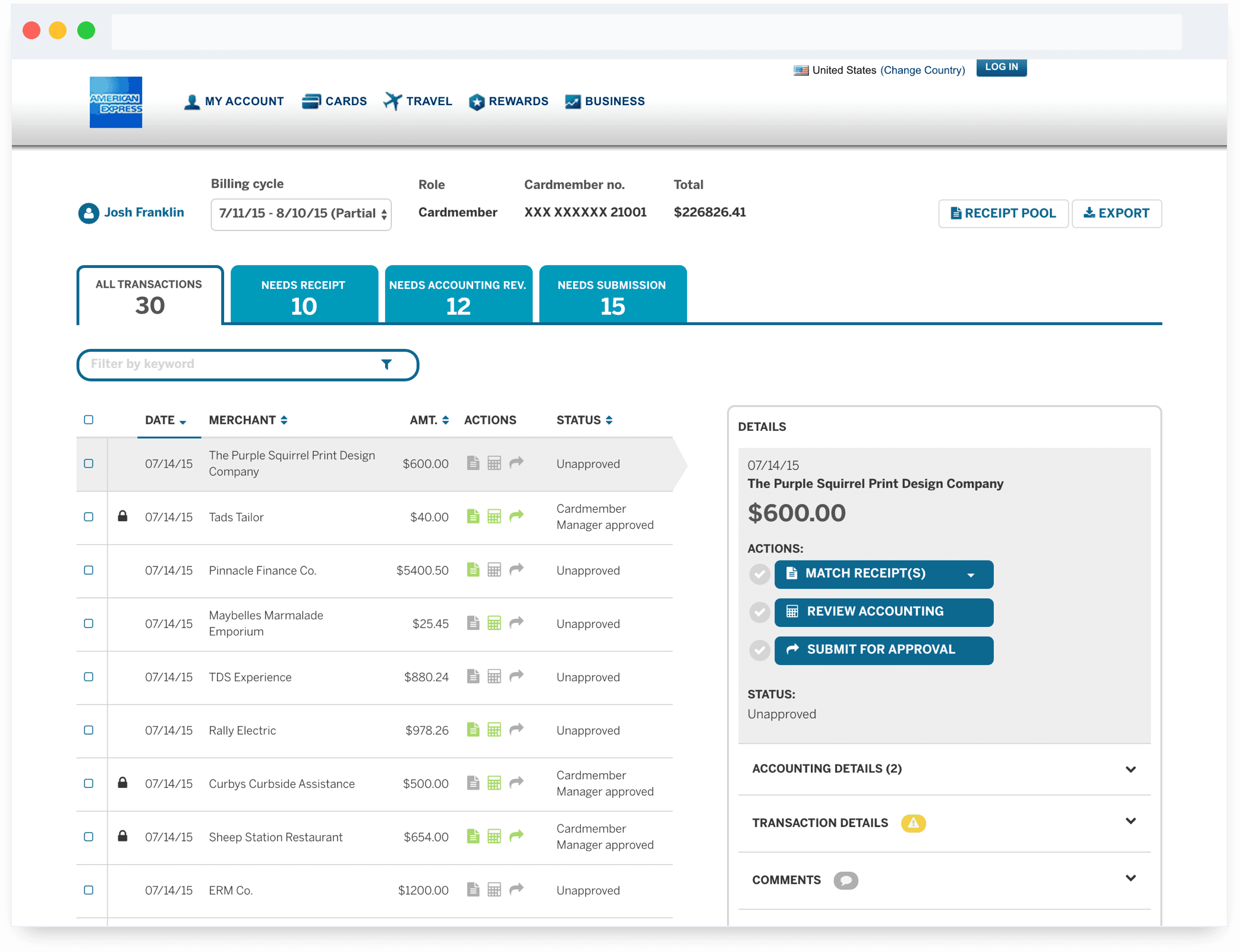
Pivotal partnered with American Express to research and redesign the reconciliation experience. We shipped a modernized tool and built a live design system that was subsequently adopted by over a dozen internal American Express teams building other corporate products.
My role
I was embedded at American Express as a Pivotal consultant, paired directly with an American Express UX designer. Together we owned the full design process: research, prototyping, and system design. I led the design system build and worked with the Amex designer to document and host it internally so other product teams could build on top of it.
Understanding the stakes
Corporate expense reconciliation isn't a casual workflow. It's used to account for every transaction on a company's corporate cards, across teams, departments, and billing cycles. For large organizations, this means significant dollar amounts, tight compliance requirements, and real consequences when something is miscategorized or missed. The users we were designing for weren't casual visitors. Many had been using this tool daily for years, and they had specific, ingrained habits built around its quirks.
We spent the first week interviewing American Express stakeholders to map the full reconciliation process and document the high-level actions the current system needed to support. The output was a detailed set of user personas and a system action map that became the shared foundation for both the Amex and Pivotal teams.
Out with the old
The existing interface had accumulated years of incremental additions without a coherent design language to unify them. Each new feature had been bolted on rather than integrated, and the result was a system that was increasingly hard to navigate. Our audit made clear that the complexity wasn't inherent to the task. It was a product of design debt.
Modernizing
Our design approach was methodical: strip the interface back to its core workflows, then reintroduce each feature prioritized by how important it actually was to users. The result was a cleaner navigation structure, a more streamlined reconciliation flow, and a mobile-first foundation that could accommodate the range of devices corporate users were on.
Building a design system that outlasted the project
From the start, we knew this wouldn't be the only Amex corporate tool that needed modernizing. Rather than designing for just the reconciliation tool, we documented every component we built into a live styleguide, hosted inside American Express's own systems so that other internal teams could access and build on top of it.
I wasn't part of the formal evangelism effort once the engagement ended. Our scope was to build it and hand it off to the Amex team to disseminate internally. But the outcome speaks to the value of designing systems rather than screens: a design system built for one project ended up shaping the experience of products across the organization, used by over a dozen internal teams.
Designing change for power users
One of the most nuanced challenges on this project was the FTUX (first-time UX) for existing users experiencing a significant redesign. These weren't new users learning the system. They were people who had built years of muscle memory around an interface we were fundamentally changing. The risk wasn't confusion. It was lost trust.
Initial testing revealed real resistance. Users didn't want to explore; they wanted to find the things they already knew how to do. We iterated the guided tour to focus less on showcasing new features and more on anchoring users to familiar workflows in their new location. The framing shifted from "look what's new" to "here's where everything you rely on now lives." That change in tone made a measurable difference in how users received the transition.