Managed Care Review
Modernizing the submission and review process for Medicaid funding
Government · Enterprise · Lead Designer · 2019–2022
Live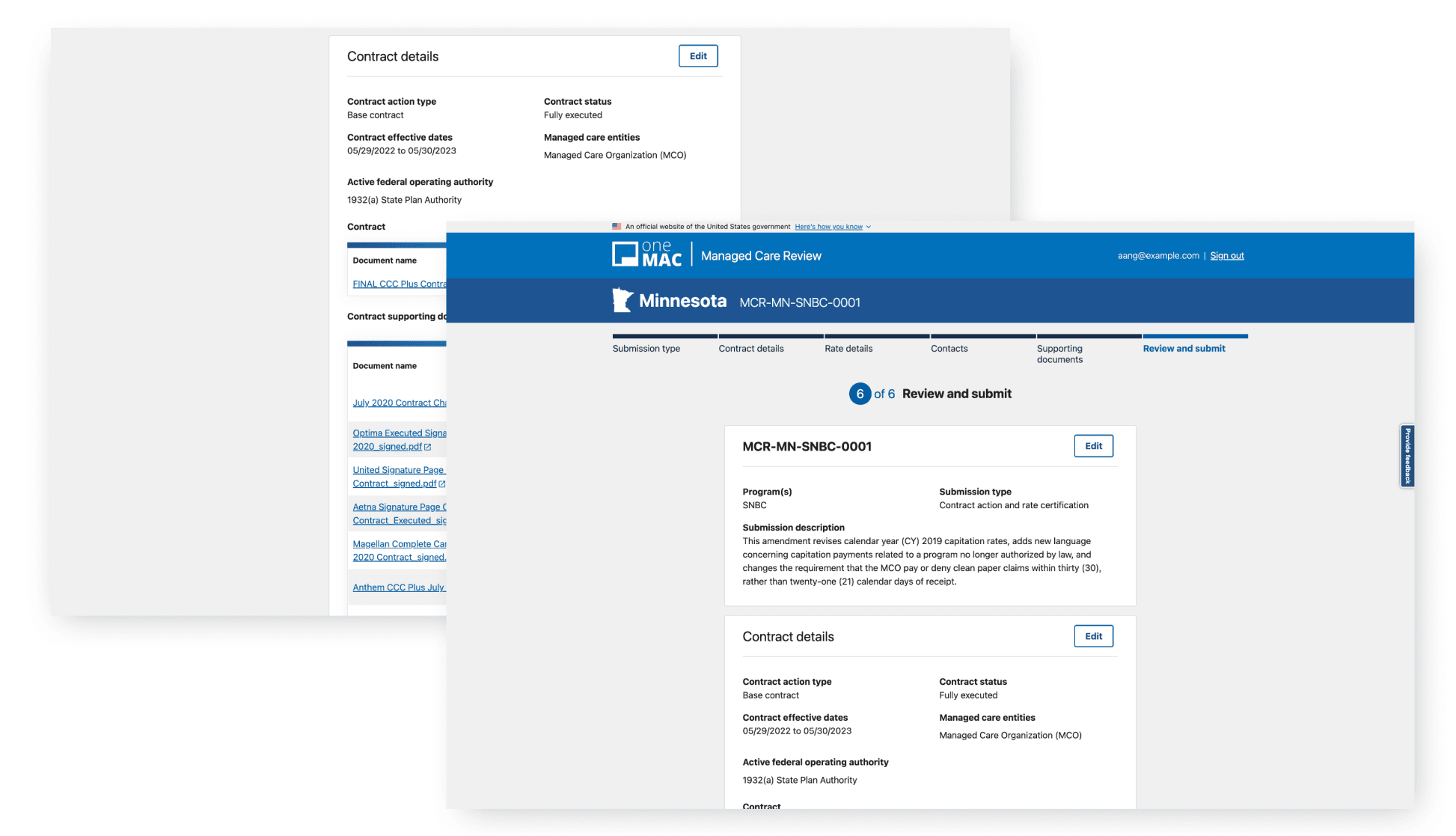
The client
The Centers for Medicare and Medicaid Services (CMS) is a federal government agency that serves more than 100 million people through Medicare, Medicaid, the Children's Health Insurance Program, and the Health Insurance Marketplace.
The challenge
States across the country submit their Medicaid managed care plans to CMS several times a year. The process was entirely manual, conducted over email with no standardization between states. In FY2017, reviews were taking an average of 254 days and had been described as a "black box" by the states submitting to it. Nobody had clear visibility into where a submission stood or why it was delayed.
The solution
CMS partnered with Truss to research and build Managed Care Review (MC-Review), a centralized platform that captures state submissions and facilitates CMS reviews in one place. We launched to 6 states and cut the submission process down by 75% and the review process down by 50%.
My role
I led design direction for MC-Review from discovery through pilot. This included planning and facilitating research with CMS and state stakeholders, owning all prototyping and concept development, managing stakeholder relationships, and later in the project, mentoring a junior designer through critiques, stakeholder presentations, and research synthesis.
0
states launched at pilot
0%
reduction in submission time
0%
reduction in review time
Discovery and framing
We spent 6 months embedded in the managed care process before designing a single screen. A cross-functional team (two designers, a product manager, and an engineering lead) conducted contextual interviews, storyboarding sessions, and design studios with multiple stakeholder groups at CMS and dozens of state employees across the country. The goal wasn't just to understand the workflow. It was to understand where the process broke down, where trust had eroded between states and the federal government, and what "good" would actually feel like to people who had been grinding through this for years.
It all starts with good data
The root cause of most of the dysfunction was a lack of standardization. CMS reviewers had to manually interpret each submission before they could even begin reviewing it. We couldn't fix the review process without first fixing the submission process, so that's where we started.
- Different file formats across every state submission
- No consistent email thread structure or naming conventions
- Documents organized differently by each state, requiring manual interpretation before review could begin
Breaking down the process
We broke the submission form into a structured multi-step process organized around the key sections CMS needed to review. This gave state users a clear sense of progress and reduced the uncertainty that came with submitting a massive, unstructured email package.
Reliable file uploads
Email attachments had a size limit. States were routinely splitting submissions across multiple emails just to get their documents through. A reliable multi-file upload component eliminated this entirely and gave both states and CMS a permanent, organized record of every document in the submission.
Submissions reorganized
The output mattered as much as the input. We designed the submission summary page to organize documentation by CMS division, so reviewers could immediately find what was relevant to them without parsing an entire package. This alone took hours off the intake process.
The case for parallel path testing
Most government software projects use a "rip and replace" approach, where the agency cuts over to the new system overnight and real problems only surface once it's in production. I pushed hard for a different approach.
We designed a parallel path testing protocol where states submitted a real Medicaid plan through both the existing email process and MC-Review simultaneously. This gave us actual production data to test against, not simulations or demo content, and let CMS continue using their existing process while we identified gaps. We conducted 9 parallel path tests over 4 months.
There was pushback from leadership. Running parallel systems meant a longer development cycle and more coordination overhead. But the case was clear: finding a missing step in testing costs days. Finding it in production costs months and erodes the trust of the states we were trying to serve.
The results validated the approach. One state was so convinced by what they saw during testing that they recruited additional agency employees to participate, not because we asked, but because they wanted internal champions who could help sell the transition to their own leadership. That kind of organic buy-in doesn't happen when you flip a switch overnight.
75% reduction in state submission time. 1.5 hours cut from CMS intake per submission. One state recruited its own internal champions — unprompted.
Pilot and rollout
In the summer of 2022 we launched a pilot program allowing selected states to make official submissions via MC-Review. The team fully onboarded 3 states to the new process, with more planned for the following months. The parallel path testing meant that by the time states went live, they already knew the system. They'd helped shape it.
If I were building this today
The single biggest remaining burden in managed care submissions is data entry. States are manually inputting structured data that already exists in their own systems: rate certifications, contract details, supporting documentation. CMS reviewers then have to re-interpret and re-enter much of it on their end.
If I were building MC-Review today, I'd design AI normalization directly into the submission pipeline. States would upload their existing documentation, and AI would take a first pass at extracting and structuring the submission data. State employees would review and confirm rather than build from scratch. On the CMS side, AI could flag inconsistencies, surface historical comparisons, and prioritize reviewer attention on the submissions most likely to have issues. The human effort shifts from data entry to judgment, which is where it should have been all along.