Fuigo
Bringing project management tools to interior designers
B2B SaaS · Head of Design · Design Systems · 2017–2020
The problem
Interior designers run complex small businesses, but the tools available to them weren't built for their world. Most were juggling spreadsheets, email chains, PDF proposals, and separate purchasing portals simultaneously. The fragmentation wasn't just inefficient; it made designers feel scattered and unprepared in front of clients. Research showed that designers were spending 70–80% of their time on administrative work, leaving little room for the actual design.
The solution
Fuigo built a web application that unified budgeting, quoting, purchasing, and project management into a single platform. The result was a tool used by 200+ designers across 30 agencies. As Head of Product Design, I led all aspects of design from early research through build, and also took on a significant portion of the front-end implementation, including ownership of the production design system.
My role
Head of Product Design. I owned the full design process: research, wireframing, prototyping, and testing. I worked directly with the CEO and product manager on quarterly roadmap planning, built and maintained the company's design system, and contributed substantially to the production codebase.
0%
reduction in admin work
0+
design firms on the platform
Research built into the business model
Fuigo's founders had spent 30 years as vendors to the interior design industry. That institutional knowledge was invaluable, but it wasn't a substitute for watching designers actually work. Because Fuigo operated a co-working space for interior designers, we had direct, ongoing access to our target users in their natural environment.
We ran weekly research sessions throughout the product's development, not as a formal process phase, but as a continuous feedback loop. Designers would show us their current workflows, tell us what was breaking down, and react to prototypes in real time. This cadence meant we were rarely surprised by what we found in testing.
Shaping the roadmap
As Head of Product Design, I wasn't just executing on a defined roadmap. I was helping to define it. Every quarter, the CEO, product manager, and I would review incoming user feedback and requests alongside company objectives to prioritize what we'd build next. Design had a seat at the table from the beginning, which meant features were scoped with user needs as a first-order input rather than an afterthought.
Design close to the code
I built Fuigo's design system and was its primary maintainer. This meant that as I made changes to components, those changes were immediately reflected in production, with no handoff lag or implementation drift. I could make a design decision in the morning and have it live that afternoon.
Beyond the design system, I took on a significant portion of the app's front-end styling as the product grew. Being that close to the code changed how I designed. I stopped thinking in abstractions and started thinking in what would actually be built, which made the design-to-engineering handoff almost disappear.
More time to design
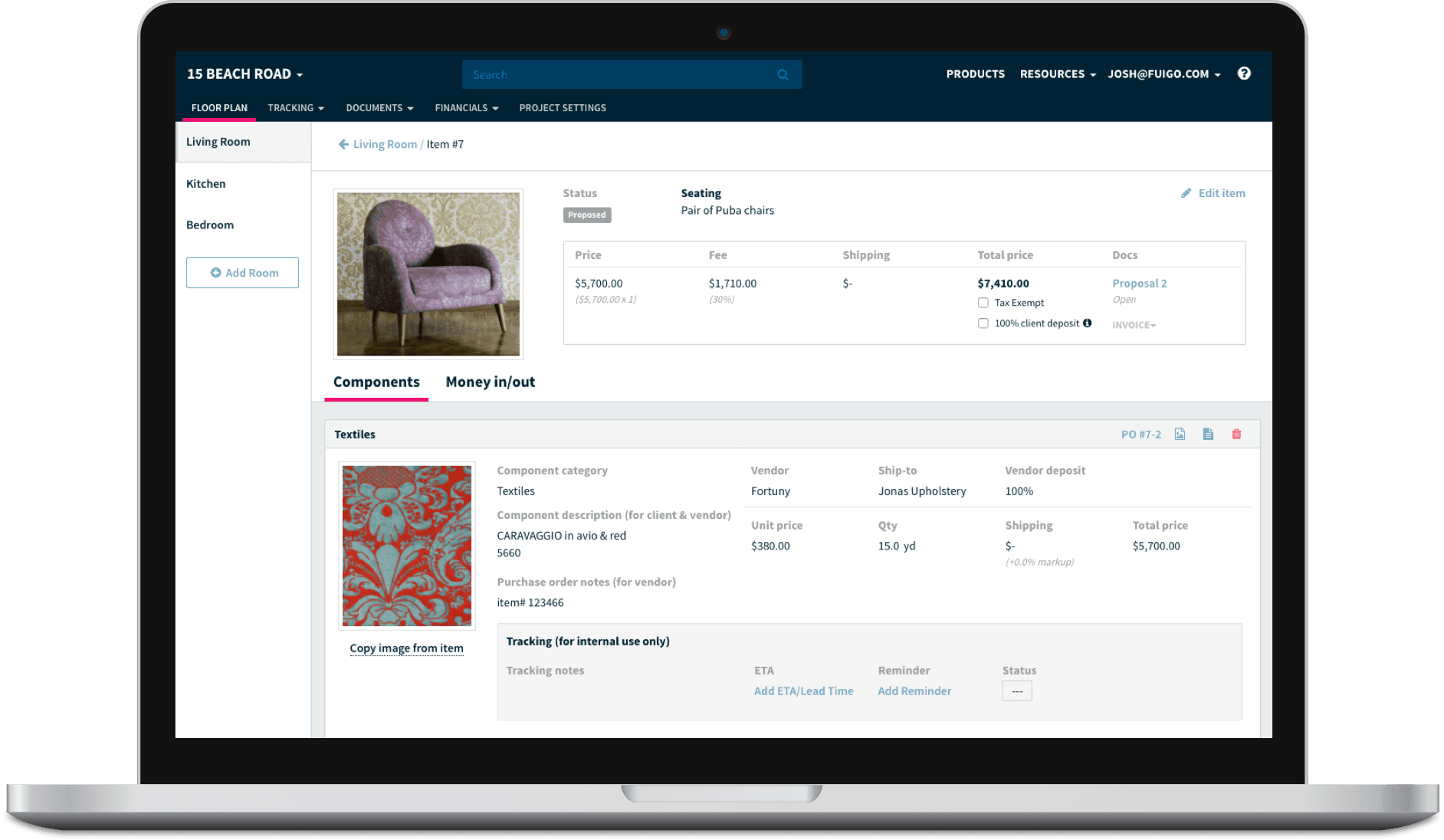
The core value proposition of Fuigo was simple: give designers their time back. By consolidating budgeting, quoting, and purchasing into one platform, we eliminated the constant context-switching that was consuming the majority of their working hours. The platform let designers quickly input items, generate well-formatted client documentation, and track the health of every project in one view.
The vendor marketplace
Midway through the product's development, we identified an adjacent opportunity: connecting designers directly to vendors. The current purchasing process required designers to research products on vendor websites, request pricing through email or phone, and manually track what was ordered and when. We built a digital marketplace inside Fuigo where designers could browse, spec, and purchase from high-end vendors without leaving the platform.
The design challenge here was different from anything else on the product. The platform had to be flexible enough to accommodate significant variation while still feeling coherent to the designer using it. We designed a unified product card and ordering interface that abstracted away the vendor-specific complexity. The designer saw a consistent experience, and the platform handled the translation on the backend.
- Each vendor had a unique pricing structure — fixed, tiered, or quote-based
- Product taxonomies varied widely across furniture, lighting, textiles, and accessories
- Ordering workflows ranged from instant purchase to multi-step trade approval processes